3/12/2010

Note

#210 | “How would it feel if a foreign policeman was beating you up in Athens? (the Greek uprising is truly going European!)

(article written by an Occupied London author for our friends at Last Hours, on the eve of tomorrow’s general strike. Continuous updates and photos, on both websites, tomorrow!)
It is early in the morning of Tuesday, March 9th. Bemused audiences tuned in to an Athens news station to listen to an evidently uncomfortable police spokesperson. How could he not be? He must explain a rather embarrassing incident: days earlier, on March 5th, the police had tear-gassed Manolis Glezos in the face for trying to prevent a youth’s brutal arrest [photo]. Glezos is 88 years old today; it was almost 70 years ago, on May 30 1941, in Nazi-occupied Athens that he and Apostolos Santas climbed up the Acropolis and tore down the Swastika – an action for which he was arrested and tortured the following year.
Trying to justify the police’s action and to show that things must stay under control at any cost, the spokesperson made quite a revealing statement: “if the local police fail at their task”, he claimed, “the EU and the Greek government are ready to dispatch a 7,000-strong European police force to repress what might seem like an upcoming revolt”. “Imagine it!”, he added, “how would it feel if a foreign policeman was beating you up in the streets of Athens?” A funny question, that one. You would imagine police baton blows feel similar regardless of the passports of those holding them. Whether or not his statement was a slip-of-tongue, it definitely seems to hold some validity: a supra-national police force, the “European Gendarmerie Force” (EGF) does exists already and is prepared to take operations in countries where local governments invite it [http://www.statewatch.org/news/2007/oct/eu-gendarmerie-treaty-sept-2007.pdf]. The Greek government have so far declined to answer questions on the issue in parliament. I don’t think Manolis Glezos was expecting to see German public forces on the streets of Athens again in his lifetime. But then again, if they tear-gas the way the Greek cops do, there won’t be that much for anyone to see…
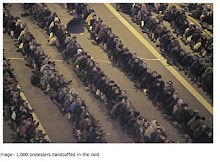
General strikes are more common in Greece than in most European countries – but still, they tend to come in the rate of one or two per year – not per calendar month. Thursday’s general strike is the country’s third (two full-day and one half-day) in the few weeks alone. Panepistimiou Avenue, part of the main protesting route – and one of Athens’ major thoroughfares – has been closed off for a week by strikers of Olympic Air; on March 10th, an attorney general ordered the police to disperse the crowd of about 2,000 who have gathered there.
The country’s official printing-house (where state laws are printed in order to come into effect) is currently occupied by employees in protest against the newly-introduced austerity plan. The general accounting office (this, ironically, in charge of monitoring the effects of the implementation of the austerity plan) is also under occupation by its employees. In the small northern city of Komotini employees at a local troubled company went straight to the source and occupied two of the city’s main bank branches.
December’s revolt had been a strong warning sign. The “700 euro generation” (in a country where everyday living expenses closely compete to the UK’s) had every reason to revolt. The death of a 15-year old boy? Cities smash and burn for days. An “austerity plan” pushing labour rights back by a few decades overnight; severe wage cuts, VAT increases, pension-freezes…
It is Wednesday, March 10th – the eve of the third recent strike in Greece. “I don’t really earn enough to get a cab to tomorrow’s demonstration”, writes a commentator on Athens IMC. “And there’s no public transport, as everyone is participating in the strike. Good for them. We are driving down there tonight, staying with a friend. And we’ll be using the car’s engine oil to wash the streets, our little gift to the thugs of the police’s motor-cycle Delta force.” There is anger building up in Athens’ streets and many expect to see it outpouring in the event that multi-national force descends in the city, if not before… Whether national or international, next time Manolis Glezos takes on the security forces he most certainly will not be alone.

3/10/2010

Failed astronaut


Failed astronaut

We had the discussion for so many times
and you’re keep on repeating
that this is the worst time
to fall in love
i say you are wrong
but who cares
i hear you are busy
sweaty like grey rat
making up new explanations
now this is now
this very moment
the moment we are talking
and we are having the conversation
this is the worst time
to fall in love
now you’re solving your life and all the conspiracies, you found the death of the fear of death, the cause-reason-effect of boring nights and numerous un-satisfactions,  the below zero degree of sexual interactions tuned in neuron plastic power, it is your cock which is materialized perfectly in nicotine candies, since the last time
we had the discussion and i had sex with you
we had sex with three men after you
every night I give birth to millions of babies
who are ghostly good looking
looking  at me when they depart from me
when all of those babies will arrive to mars
you will still be here on this planet.

Note

Pathological Liar/Stalker
March 12th-April 3rd 2010
Fredric Snitzer Gallery 2247 NW 1ST PL Miami, FL 33127
I am a fan of places I've never been to. Where I live, nobody knows you, nobody has
met you yet. You are contingent to my screen-saver, to the thousands of headless torsos in the chat-rooms... I am your audience and as such, at some point, I felt like I was dating my father or my mother (for the impossibility of it). I find that with you, truth reveals itself in a fictional structure; and the reality of our construction depends on the relational aspect of that exchange and also on the contraband of your photo. Since I 'met' you, my reality became abstraction and like on the verge of modernism you where built as speculation while I turned into a verb. In these paintings, I have no interest in the narratives of what went down between us, but instead, I focused on how for desire to remain desire it had to ignore the very mark that constructed it as such. If I have to locate desire in your body or in mine, it will be in the head. I’m omitting it now. I’m not sure if the word representation would be the right one here, maybe yes, I rather think of these paintings as presentations. Or the discourse without text for the ads and the posters I’m distributing in Europe to find you. In any case, as I was saying, the subjects depicted are sometimes generic headless totems, rocks that look like people, unfinished torsos from bad sculptors in the 30’s, red jackets and black pants ‘walking’ backwards and forward. They sort of echo the basic premise for exchanging one’s own nude photos on the chat room: Always headless, nobody will know who you are...You’ll avoid blackmail. I only have headshots of you; you never got one from me. On our chat sessions 3 modes of exchange took place. I build you up, I erase; I attack. In all 3, there was the possibility of losing control materially, of not being able to direct that curve, or this conversation. The paintings that came from the chat room are now becoming a poster, an ad, a letter. So, in that (sort of) state of becoming, the performance that was started by your image became extra-pictorial drama, and at the end, what was left wasnʼt just a bunch of photos or paintings or letters, but rather the scene of our exchange, its process and the memory of it's materiality, whatever that was. Diego Singh. Miami, February 2010.
3/08/2010

Note

"And Counting..." Wafaa Bilal is performing for 24 hours at the Elisabeth Foundation for the Arts


“And Counting… is the location Bilal’s performance creates. This decisive, irreversible action will establish an embodied, and, as long as Wafaa Bilal is alive, timeless memorial to the nightmare of the Iraq war, with the war’s most devastating consequences engraved not only in Bilal’s consciousness but also approximated in the flesh.
Once the map of Iraq is tattooed onto Wafaa Bilal’s back and the 5,000 red dots representing fallen U.S. soldiers are met by the 100,000 green dots designating fallen Iraqis, the latter visible only under UV light, there is no turning back. Tattoos are almost impossible to erase, as many soldiers have learned. They are a constant reminder of an irrevocably decisive moment. Monuments, by contrast, although built with good intentions and designed to help us remember, often simply accelerate our capacity to forget. They inevitably become absorbed into our visual landscape. Remembering is directly connected to the body—sensual stimuli activating hidden memories all the way back to childhood, as Proust, for one, demonstrated with such elegance. So the act of engraving memory onto oneself is an attempt to secure an everlasting re-membrance of the past. "  Carol Becker

3/04/2010

Note

KS: The myth of Orpheus and Eurydice provides a much more compelling account of gender than does Oedipus myth- one based on mortality instead of castration. The story is also crucial because it helps us to see the foundational nature of gender: The turn away from woman is a turn away from all relationality. Ovid gives the myth a redemptive coda as well. In Book XI of the Metamorphoses, Orpeus is attacked by a band of women who say "Look there's the man who hates us" They strip him of his power to coerce and compel nature, and they dismember his body. Orpheus is transformed by death. When he arrives in Hades, he searches for his "dear" Eurydice and, when he finds her, lovingly embraces her. They spend their time walking side by side through Hades and reenacting what happened on the slope leading from Hades to earth in a way that undoes its violence- turning it into a reversible and ontologically equalizing analogy. Sometimes Eurydice walks ahead and Orpheus follows, and at other times he walks ahead and she follows; and when it is his turn to look back, his look no longer kills. In the first part of his version of the myth, Ovid tell us what heterosexuality is. In the second, he shows us what heterorelationality would look like- if we were ever to have it.


Artforum, February 2010, George Baker in conversation with Kaja Silverman 

3/03/2010

I Formations, Design, 2009


INPUT at the Armory Show 2010


INPUT
The Armory Show 2010
The Collective Booth (L-18 on Pier 92)
March 4-7

INPUT #2: Spring 2010
Me, Myself and I (Conversations with Oneself)
Limited Edition of 300

Renée Vara, Executive Editor
Elena Bajo + Warren Neidich, Guest Editors

CONTRIBUTING ARTISTS

Meena Alexander, Avi Alpert, Eric Anglès, Marco Antonini, Boško Blagojević, Daniel Bozhkov, Tyler Coburn, Jon Cuyson, Keren Cytter, Judy Dater, Josechu Dávila, Jeremiah Day, Jonatan Habib Engqvist, Andrea Fraser, Vendela Fredricson, Pablo Helguera, Claire Hooper, Alexis Knowlton, Chris Kraus, Ajay Kurian, Sean Landers, Annika Larsson, Thomas Lawson, David Maljkovic, Amir Mogharabi, Anneè Olofsson, Alix Pearlstein, Falke Pisano, Angelo Plessas, Adina Popescu, Ana Prvacki, Sean Raspet, Georgia Sagri, Jakob Schillinger, Amie Siegel, Alexandre Singh, Andrew Smaldone, Erik Smith, Gabriele Stellbaum, Mathilde ter Heijne, Eve K. Tremblay, Heidi Voet, Martha Wilson

Me, Myself and I (Conversations with Oneself)

What is the role of the dialogic process in the production and construction of art?

The focus of this iteration, a project by Elena Bajo + Warren Neidich, is specifically centered on the simultaneous dialogues artists have with themselves including their associated internal conflicts and diatribes.  As a dialogic exercise of self-discovery and/or reflexive mindfulness, this edition of INPUT seeks to explore how an artwork becomes a disembodied representation of an artist’s internal voice in all its contradictory and multifarious nature. 
INPUT is a new aesthetic journal published by a nonprofit foundation directed under the curatorial mandate of “rotating guest editors” to produce interventions, actions and ideologies on contemporary currents and cultural conditions. Since change is the one constant in contemporary culture, INPUT seeks to capture the ephemeral and momentary visions of artistic conceptualism and free the medium from the typical monotony affiliated with commercial publications. Produced in bi-annual, limited editions, INPUT approaches the medium of the journal as an exhibition.
For subscription information please email

2/21/2010

Note

Parallel of Life and Art ICA, 1953, London

The Smithsons became in involved with the Independent Group as Peter was teaching at the Central School of Art and Crafts, London with Eduardo Paolozzi, who introduced them to Nigel Henderson in 1952. The Smithsons, Paolozzi and Henderson proposed the exhibition, Parallel of Life and Art to the ICA in March 1952 via Dorothy Morland, whom Paolozzi knew. The proposal was finally accepted in January 1953 with the support of Roland Penrose and sponsorship from Peter Gregory, Roland Jenkins, Jane Drew and Denys Lasdun. The exhibition was similar to Richard Hamilton’s Growth and Form in that it spanned science and art and created a total environment with a host of black and white images taken from a range of art and non-art sources. Curated by Reyner Banham, the show was polemical and controversial, the images shared an overall crudeness, vulgarity and rawness. This was not beautiful art, but processed images juxtaposed randomly. The exhibition also had a pedagogic purpose, and when the exhibition finished at the end of 1953, the panels were moved to the Architectural Association in Bedford Square, London where a stormy discussion took place on 2 December 1953, chaired by Banham. He referred to the debate in his seminal article ‘New Brutalism’ which celebrated the work of the Smithsons:
…students at the Architectural Association complained of the deliberate flouting of the traditional concepts of photographic beauty, of the cult of ugliness and ‘denying the spiritual in Man’. (Architectural Review, December 1955, p356)
The cover of the exhibition catalogue of 'Parallel of Life and Art', 1953

The cover of the exhibition catalogue of Parallel of Life and Art, 1953

Installation shot of the exhibition, 'Parallel of Life and Art', 1953

Installation shot of the exhibition, Parallel of Life and Art, 1953

It was by means of this exhibition and the creative collaboration with Henderson and Paolozzi that the Smithsons became involved in the Independent Group. The first, 1952–3 session of the Group had come to an end, and during 1954 the Group contributed more to the public programme at the ICA, including the lecture series Aesthetic Problems of Contemporary Art. Lawrence Alloway and John McHale convened the second session of the Independent Group on the theme of fine art and popular culture. Peter Smithson contributed to the fourth session in April 1955 on Advertising with Alloway, Paolozzi and McHale. An evening in which the Group focussed on American advertising imagery and symbolism.
The Independent Group stopped meeting towards the end of 1955, but the creative collaboration which lay behind its success continued throughout the lifetimes of the erstwhile members. In many ways, the apogee of the Group was the exhibition This is Tomorrow at the Whitechapel Art Gallery in September and October 1956. The show consisted of twelve separate spaces, constructed by twelve groups of architect, sculptor and painter. The Smithsons created thePatio and Pavilion area with their old Parallel of Life and Art team, Nigel Henderson and Eduardo Paolozzi. It consisted of a makeshift ‘lean to’ and patio area, strewn with random objects. Collaboration continued beyond This is Tomorrow,with Banham authoring a book on New Brutalism: Ethic or Aesthetic? in 1966. The Smithsons continued to work with Independent Group preoccupations with their design for the ephemeral, House of the Futurefor the Ideal Home exhibition in 1956 their article, ‘But Today We Collect Ads’ in ARK November 1957.
Poster from the This is Tomorrow exhibition