Story Line
A perfect tragedy should be arranged not on the simple but on the complex plan. It should moreover imitate the actions which excite pity and fear, this being the distinctive mark of tragic imitation. It follows plainly, in the first place, that the change of fortune presented must not be the spectacle of the virtuous man brought from prosperity to adversity: for this moves neither pity nor fear, it merely shocks us. Nor, again, that of a bad man passing from adversity to prosperity: for nothing can be more alien to the spirit of tragedy; it possesses no single tragic quality- it neither satisfies the moral sense nor calls forth pity or fear. Nor, again, should be downfall of the utter villain be exhibited. A plot of this kind would doubtless satisfy the moral sense, but it would inspire neither pity nor fear; for pity is aroused by unmerited misfortune, fear by the misfortune of a man like ourselves. Such an event, therefore, will be neither pitiful nor terrible. There remains, then, the character between these two extremes- that of a man who is not eminently good and just, yet whose misfortune is brought about not by vice or depravity but by some error or frailty. He must be one who is highly renowned and prosperous.
A well constructed plot should therefore be single in its issue, rather than double as some maintain. The change of fortune should be not from bad to good, but, reversely, from good to bad. It should come about as the result not of vice but of some great error or frailty, in a character either such as we have described, or better rather than worse. The practice of the stage bears out our view. At first the poets recounted any legend that came in their way. Now, the best tragedies are founded on the story of a few houses - on the fortunes of Alcmaeon, Oedipus, Orestes, Meleager, Thyestes, Telephus, and those others who have done or suffered something terrible. A tragedy, then, to be perfect according to the rules of art, should be of this construction.
Questions:
What is the role of the chorus in the drama? How does the chorus follow the character?
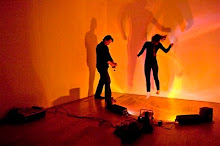
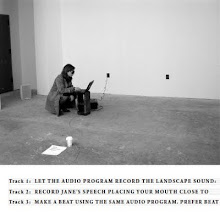
For performance art, the drama is already staged and the performer returns the role of the audience to the audience, by embodying different states of spectatorship.
The performer is a spectator, meaning she is already part of an ongoing spectacle that she responds to. She is a part of the spectacle, she is not outside nor inside, she is already a part of it. Does then a performance piece need a plot? No, and that's what makes performance art different to theater or any other performance (music, dance, cinema) because it mostly demands the performer's actuality and truthful response to the ongoing, present drama, life as it is. It is the way chorus responds to Oedipus or speaks the secrets of Antigone. If life as it is, it is already a spectacle, her response to the main characters turns flat. The chorus is the agora already on stage. This is how it is and it is part of the performance to show that there is a way that this body, our bodies on stage, can take responsibility for the acts of the main characters, the rulers of the drama. If there is something to focus upon now it is the making of that body, how to awaken it, how to create the language and the movements that speaks, and how they can be activated.
Is it possible to understand that there is no separation between drama and real life?
If everything is spectacle including our own bodies what she wants to show is that she still can receive as if for the first time and the gestures will be of that exact moment. The gestures cannot be fully prepared yet cannot exist without ground, without memory, a memory of reality. They can't be from something personal, as they will limit her focus, but they can't be without her heart because that will limit her expressions. The choric body, khoriko soma, which occupies but doesn't territorialise, which speaks out truth, undefined but specific in movement.
Some performances want just to add another layer of spectacle on the existing one by using the same violent, grotesque tricks. Others assume that violating the body will give examples of how spectacle can be harmed but in the end they only achieve alienation. Some want just to comfort themselves and all of those around them, to make them forget, to make them sleep a deeper sleep than they are already in.
As, I understand it, there is not an either or not, there is neither against or acceptance, but response. Response maybe replaced with the word come back or feedback but maybe it is not the right word. I am using this word without the reactionary root which it carries, but well, this come back, this response, the feedback, has nothing to do with tricks and examples. It is immediate and it is actual and it is disturbing how more actual it can be.
So when the performance starts?
Does it end?
Does it need to be good?
For the witch, ruptures come in time and out of smell.


3/24/2010
3/23/2010
Note (from Cocteau to somewhere of less loneliness)
From Cocteau
Free to choose the faces, the shapes, the gestures, the tones, the acts, the places that please him, he composes with them a realistic documentary of unreal events. The musician will underline the noises and silences.
to somewhere of less loneliness
Free to choose the faces, the shapes, the gestures, the acts, the places that please us, we compose a realistic documentary of unreal events. We are actors and at the same time composers and we will do music which will underline our noisy and silent acts.
Free to choose the faces, the shapes, the gestures, the tones, the acts, the places that please him, he composes with them a realistic documentary of unreal events. The musician will underline the noises and silences.
to somewhere of less loneliness
Free to choose the faces, the shapes, the gestures, the acts, the places that please us, we compose a realistic documentary of unreal events. We are actors and at the same time composers and we will do music which will underline our noisy and silent acts.
Note (Cixous)
She must write herself because this is the invention of a new insurgent writing which, when the moment of he liberation has come will allow her to carry out the indispensable ruptures and transformations in her history, first at two levels that cannot be separated.
a) Individually. By writing her self, woman will return to the body which has been more that confiscated from her, which has been turned into the uncanny stranger on display- the ailing or dead figure, which so often turns out to be the nasty companion, the cause and location of inhibitions. Censor the body and you censor breath and speech at the same time. Write your self. Your body must be heard. Only then will the immense resources of the unconscious spring forth. Our naphtha will spread, throughout the world, without dollars-black or gold-nonassessed values that will change the rules of the old game. To write.
An act which will not only "realize" the decensored relation of woman to her sexuality, to her womanly being, giving her access to her native strength;
a) Individually. By writing her self, woman will return to the body which has been more that confiscated from her, which has been turned into the uncanny stranger on display- the ailing or dead figure, which so often turns out to be the nasty companion, the cause and location of inhibitions. Censor the body and you censor breath and speech at the same time. Write your self. Your body must be heard. Only then will the immense resources of the unconscious spring forth. Our naphtha will spread, throughout the world, without dollars-black or gold-nonassessed values that will change the rules of the old game. To write.
An act which will not only "realize" the decensored relation of woman to her sexuality, to her womanly being, giving her access to her native strength;
3/22/2010
Note
By this drop of your blood, I can see through your dynamic impulse. All the murdered lips mark hollow stars. With sparked arch and sparked ankle. This is this. If you like it. Dig me with no end, more inside. continue repeat. The thick painted red, which was always sweating by our enormous humidity, needs no detailed explanation. Zoom in. She and He speak in reverse.
Note
Excuse me..
blue background
hands and feet in opposite directions
She is strange, with short hands
different when standing on her toes
whistle
the triumph of youth
Reject habits
run with me
faster than beauty
blue background
hands and feet in opposite directions
She is strange, with short hands
different when standing on her toes
whistle
the triumph of youth
Reject habits
run with me
faster than beauty
3/16/2010
Note
Constant rejection of preservation,
without others there is no survival-the ecstatic is not immanent
Not out of dialectics, out of absolutes
Letting go
To detach
Temporality
the time is the concept of itself
Dialectic without completion, a shape outside the seen, the form can only be presence
The face cannot be plastic
The otherness of other cannot be form
Self-fashioning
Strategy and hiding
At once two and in a distance
Scene
to arrive at a scene
to assume shape
shape is not matter
it derives within itself
time again that defines any given shape
Try alternatives alter alternatives
without others there is no survival-the ecstatic is not immanent
Not out of dialectics, out of absolutes
Letting go
To detach
Temporality
the time is the concept of itself
Dialectic without completion, a shape outside the seen, the form can only be presence
The face cannot be plastic
The otherness of other cannot be form
Self-fashioning
Strategy and hiding
At once two and in a distance
Scene
to arrive at a scene
to assume shape
shape is not matter
it derives within itself
time again that defines any given shape
Try alternatives alter alternatives
3/14/2010
This is a party, Athens/NY, 2007
Where are we my friends?
We are nowhere
And we are here again and again
I feel how real you are
Open mouth
No teeth
This is a house
No, but maybe yes
It could be a dog
A very happy dog
This is nothing
I’m here for no reason
This is nothing
And I’m nothing at all
If the party stops
It’s only depressive normality, extreme separations.
Depressive normality, lonely crowds, impossible utopias, society of society for society
This is a party
A collection of places, infrastructures, dreams, nightmares, bodies, thoughts and desires
Desires that circulate among us among the places we move and meet
What about, the formation of sensibility as a force
The sensual of the sensitive
Of the sensitive sensuality
The relationship as no way meeting from the accident to the no resisting full ending
Or starting again and again
We are nowhere
And we are here again and again
I feel how real you are
Open mouth
No teeth
This is a house
No, but maybe yes
It could be a dog
A very happy dog
This is nothing
I’m here for no reason
This is nothing
And I’m nothing at all
If the party stops
It’s only depressive normality, extreme separations.
Depressive normality, lonely crowds, impossible utopias, society of society for society
This is a party
A collection of places, infrastructures, dreams, nightmares, bodies, thoughts and desires
Desires that circulate among us among the places we move and meet
What about, the formation of sensibility as a force
The sensual of the sensitive
Of the sensitive sensuality
The relationship as no way meeting from the accident to the no resisting full ending
Or starting again and again
Sadness comes when I can’t touch your face. When you think that relations are only for you and me and not for him, who I desired just for ones, in a bar
You hate my character
I hate your flat imagination
You hate my character
I hate your flat imagination
This is our party
Me, and my friends have a party
We have been raised as survivors
We have been raised with concepts and projects
An assumption that everything must be tolerated, that everything can be thought so long as it is recognized as being without direct repercussions on the structure of society, of its institutions and of state of power
Any idea can be admitted; its expression should even be favored, so long as the social and the state rules are accepted
The freedom of thought must be total, as well as the freedom of expression in principle, but we must not want the consequences of our thoughts as far as the collective life is concerned
Me, and my friends have a party
We have been raised as survivors
We have been raised with concepts and projects
An assumption that everything must be tolerated, that everything can be thought so long as it is recognized as being without direct repercussions on the structure of society, of its institutions and of state of power
Any idea can be admitted; its expression should even be favored, so long as the social and the state rules are accepted
The freedom of thought must be total, as well as the freedom of expression in principle, but we must not want the consequences of our thoughts as far as the collective life is concerned
No, this is not a house
This is not a temple
But who owns the keys?
We want the keys and no one knows where we can find them
You should have the keys
Don’t you?
This is not a temple
But who owns the keys?
We want the keys and no one knows where we can find them
You should have the keys
Don’t you?
We don’t have any keys and we walk on the desert
We don’t care how many days or nights
We don’t need the keys
Because
We shall see
Two or three comments for the design, please
It really has two plans
We don’t care how many days or nights
We don’t need the keys
Because
We shall see
Two or three comments for the design, please
It really has two plans
with Allison Katz, 2008
A.K What is your understanding of the difference between Desire and Pleasure?
G.S Desire is an unspeakable essence that exists outside of me and needs me to complete its purpose. Desire exists for me without me. Navigates my steps and I am the where and how that doesn’t exist yet with me. Desire is not an object, it’s the impulse to make, an impulse to do something in relation to someone who you desire in order the desire to exist.
Pleasure is complete
No thinking about pleasure
Pleasure exists in the mind of heart
A.K Where is the body?
G.S
Body is earth
Earth doesn’t have any purpose to stop it’s rhythm
Layers
Archaic evidences
The skin
More
Holes
No
Surface
Digging inside the earth
More layers
Stretched evidences
Naming again
A.K What time is it?
G.S Sun on the leaves of orchids
A.K How did you know?
G.S I knew by love
A.K Do you agree with Kristeva, "Psychoanalysis tells us there is no dialogue, just desires clashing, forces colliding"?
G.S
I knew by love
And
There
there
Was no dialogue
A.K Do you agree with Joan Didion, working through the question "of whether or not you could go home again," writing in 1967, that "Sometimes I think that those of us who are now in our thirties were born into the last generation to carry the burden of 'home,' to find family life the source of all tension and drama."
G.S
Home is blue details
on the corners of each door
I am with
You
Touching the walls
Smelling your effort to protect us
My mother
In the family
On the table
That we eat our bread every day
That’s how
I learned
It
I don’t know anything about Didion
A.K What comes to mind when I write the name A N N A A H K M A T OVA?
G.S A long narration/ Something with a tragic beginning and a tragic end
A.K A poem of yours, please:
G.S
Poem
A tiger mouse
A.K And in the year 2012?
G.S
Only weather reports for an entire year
Heavy rains like in the tropical forests
A.K The compliment of color is _light again_________. Bonus:
One of Gaugin's most beloved paintings is titled, "Where Do We Come From? What Are We? Where Are We Going?"
Romance or Anarchy?
G.S
Anarchic Romance
New Seductions
Εγγραφή σε:
Αναρτήσεις (Atom)