5/03/2010

Note

I hate vampires
Lately there have been bunch of them around
I don't mean to be aggressive but
Sometimes it just happens
I don't believe in the spirituality 
Of anyBody
I am not vegetarian either
I was once 
and it felt I was thinking too much
The body
is movement-image
Four dimensional
So, it is not flat
It is changeable 
It travels
And it
breathes
So, I don't need to exercise a lot
Copying
Miming
Writing again
From what it was written
Speaking again
From what it was said
And later finding something
to work with
With the facebook friends
Invisible qua visible in the moment
Surviving and vulnerable
As it can be
What its skin is able to sensor?
Urban environments 
Network communities
Exiles
Wars
From what the body is made of?
Holes
Abstract signs
Translations
Upon translations
Voice
Rhythms
Intensities
Pitches
Volumes
Speakers or microphones
Both

Center 
made by 
Its
Exits

4/15/2010

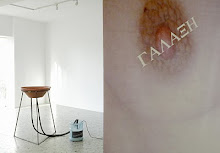
Marina Abramovic Toy, 2010

Note to NY

Hello NY,

You look very very pretty today
I like the way you smell, some kind of a perversive sticky little thing in the air
and the trees are greener and the chicken ready to go
I like it here on the bench when i lean on the side and i catch a side of yours
returning home, one or the other, closer is a dog, further away a black bird
one's plastics left over, nails holding dirt

If you promise me you'll stay pretty i'll stay more

4/13/2010

Note

When I use the I in my notes it doesn't mean that my notes are personal or refer to me.
Also, that I doesn't mean one I, my I and only. The notes are texts that carry a certain function because they depend on another text in order to appear. In comparison to any other form of written text the note can be found stuck on a fridge, it can sometimes be a doodle, one sentence, fragment of thought written parallel to a printed text inside a book, in a magazine, on a receipt, on a staple. Notes are peripheral texts that add, erase, make comments and file. The underlined text in a book is also a note. When you read and you exclude a passage from the whole by underlining it, most times you are using a pencil or a pen or these fluo markers which I remember liking when I was little, but at that time I was underlining everything. Anyways, similarly when I have a fragment written here, it is an underlined text taken from a book or a magazine or it is a text I found somewhere, maybe I can call it underline instead of note. Well, hm, I'll keep it with this name for now. The note name.

4/11/2010

Note/ Guy Debord/ Howls for Sade (fragment)

Voice 2: We were ready to blow up all the bridges, but the bridges let us down.

Voice 1: Twelve-and -a-half-year-old Madeleine Reineri, who under the stage name "Pirouette" starred in the Alpes-Grenoble radio program Happy Thursdays, threw herself into the Isere River.

Voice 2: Mademoiselle Reineri of the Europe Quarter, you still have your wonderstuck face and that body, the best of promised lands. Like neon lights, the dialogues repeat their definitive truths.

Voice 1: I love you.

Voice 4: It must be terrible to die.

Voice 1: See you later.

Voice 4: You drink far too much.

Voice 1: What are childhood loves?

Voice 1: I knew it. And there was a time that I regretted it very much.

Voice 4: Whould you like an orange?

Voice 1: The beautiful breakups of volcanic islands.

Voice 1: In the past.

Voice 4: I have nothing more to say to you.

Voice 2: Once again, after all the untimely answers and the aging of youth, night falls from on high.

Voice 2: Like lost children we live our finished adventures.

4/03/2010

Note/ if i was to make movements for this text i would love to be the door

1. Configuration of the Room Entrance

1.1 Entrance to the room is made more difficult by the need to negotiate six steps.

1.1.1 The steps lead 'upwards', to a 'higher' plane.

1.2 The door is located on the stairs (second step) This poses a further, but not the final, difficulty.

1.3 Blocked by the risers, the door only opens outwards, away from the stairway, much like those pivoting barriers, at certain border crossings that are set up against concrete blocks, so they can only open opposite the direction of travel.

1.3.1Opening the door forces one to take a step backwards, down on the first step

(p.92)

The Poetics of a Wall Projection
Jan Turnovsky

4/02/2010

Note

When you are back lingering me from the point of question to the question mark I am out. Your ceiling demonstrates suffering and I can't stand watching it. I closed the door behind, it is the same morning. You are asleep and I am counting stars. Animals in diagrams, thinking ways of shrinking. Hold my throat/stab my back/squeeze my nipple/scratch my ear/bite my fingers/ lick my head/stand on your feet/fall down/ all/ tender kiss me/glue me on your chest and try elsewhere. This is how the night unfolds and now I only see the question marks.

There is no certainty, we are words; the closer i look at you, the further away you move, the closer you look at me the further away I move

3/30/2010

Note

There is a particular thing I enjoy using only my portable computer or any random computer to make something. First of all I don't need to set up again and again a kind of a personal environment in order to focus. When I switch on my computer my environment is in front of me and it is waiting for me. When I use a random computer I can very easily set up an environment by uploading files from my hard drive, from dvds and documents out of my email account. On the screen I have folders, shapes and ideas. I don't need to go to any store, wonder around, searching for what I need and what it would be useful for me to use. Archives, articles, folders, staff in general are such a complicated thing. You need at least a permanent address to own shelves and a room to have pencils, folders with images and heavy duty books. But if you don't have specific address, if you don't find it appealing to work full time jobs to pay the rent and if work is not one of your favorites, maybe you just end up hung out here and there. The other day I went to the Pearl, the art store on Canal street, and I felt so confused. All this brushes and paints and things I didn't know why I had to get even one of them to use. There was this red pastel and it was another red beside it and then another and another. They looked so much the same the one beside the other and it didn't make to me any difference if they differ even a tiny bit as they were on the same shelf with the similar uniformed labeled template, it made me nervous even to watch them. Then, I thought well, in order to spend time with them and figure out their differences and how to use them, I had to either buy them or steal them; and then on top of that I needed paper and bla bla bla and I forgot why I needed to put those reds on a paper in the first place. I will do the test on a blank document see the differences and figure out how it does it and if it does something I will save it and keep it on one of my folders. Maybe, not necessarily soon, perhaps at a particular moment, it will become something.
Possible a copy, there won't be any bricks if you wonder what is behind the curtain, it might become three or four dimensional. It could be made out of a material which possesses fast appearances and disappearances. What kind of material would that be? Digitized signals, waves, electric colorful pigments of movement; and meanwhile, until my file will shift dimensions, I can choose to do nothing.

3/25/2010

Note (Aristotle from Poetics) and questions

Story Line

A perfect tragedy should be arranged not on the simple but on the complex plan. It should moreover imitate the actions which excite pity and fear, this being the distinctive mark of tragic imitation. It follows plainly, in the first place, that the change of fortune presented must not be the spectacle of the virtuous man brought from prosperity to adversity: for this moves neither pity nor fear, it merely shocks us. Nor, again, that of a bad man passing from adversity to prosperity: for nothing can be more alien to the spirit of tragedy; it possesses no single tragic quality- it neither satisfies the moral sense nor calls forth pity or fear. Nor, again, should be downfall of the utter villain be exhibited. A plot of this kind would doubtless satisfy the moral sense, but it would inspire neither pity nor fear; for pity is aroused by unmerited misfortune, fear by the misfortune of a man like ourselves. Such an event, therefore, will be neither pitiful nor terrible. There remains, then, the character between these two extremes- that of a man who is not eminently good and just, yet whose misfortune is brought about not by vice or depravity but by some error or frailty. He must be one who is highly renowned and prosperous.
A well constructed plot should therefore be single in its issue, rather than double as some maintain. The change of fortune should be not from bad to good, but, reversely, from good to bad. It should come about as the result not of vice but of some great error or frailty, in a character either such as we have described, or better rather than worse. The practice of the stage bears out our view. At first the poets recounted any legend that came in their way. Now, the best tragedies are founded on the story of a few houses - on the fortunes of Alcmaeon, Oedipus, Orestes, Meleager, Thyestes, Telephus, and those others who have done or suffered something terrible. A tragedy, then, to be perfect according to the rules of art, should be of this construction.


Questions:

What is the role of the chorus in the drama? How does the chorus follow the character?
For performance art, the drama is already staged and the performer returns the role of the audience to the audience, by embodying different states of spectatorship.
The performer is a spectator, meaning she is already part of an ongoing spectacle that she responds to. She is a part of the spectacle, she is not outside nor inside, she is already a part of it.  Does then a performance piece need a plot? No, and that's what makes performance art different to theater or any other performance (music, dance, cinema) because it mostly demands the performer's actuality and truthful response to the ongoing, present drama, life as it is.  It is the way chorus responds to Oedipus or speaks the secrets of Antigone. If life as it is, it is already a spectacle, her response to the main characters turns flat. The chorus is the agora already on stage. This is how it is and it is part of the performance to show that there is a way that this body, our bodies on stage, can take responsibility for the acts of the main characters, the rulers of the drama. If there is something to focus upon now it is the making of that body, how to awaken it, how to create the language and the movements that speaks, and how they can be activated.
Is it possible to understand that there is no separation between drama and real life?
If everything is spectacle including our own bodies what she wants to show is that she still can receive as if for the first time and the gestures will be of that exact moment. The gestures cannot be fully prepared yet cannot exist without ground, without memory, a memory of reality. They can't be from something personal, as they will limit her focus, but they can't be without her heart because that will limit her expressions. The choric body, khoriko soma, which occupies but doesn't territorialise, which speaks out truth, undefined but specific in movement.
Some performances want just to add another layer of spectacle on the existing one by using the same  violent, grotesque tricks. Others assume that violating the body will give examples of how spectacle can be harmed but in the end they only achieve alienation. Some want just to comfort themselves and all of those around them, to make them forget, to make them sleep a deeper sleep than they are already in.
As, I understand it, there is not an either or not, there is neither against or acceptance, but response. Response maybe replaced with the word come back or feedback but maybe it is not the right word. I am using this word without the reactionary root which it carries, but well, this come back, this response, the feedback, has nothing to do with tricks and examples. It is immediate and it is actual and it is disturbing how more actual it can be.


So when the performance starts?
Does it end?
Does it need to be good?


For the witch, ruptures come in time and out of smell.


3/24/2010

Note

Hi flower
under the shadow
there is a flower
Approach.