7/25/2011

Live Portfolio 2007-2011

Live Portfolio
Saturday, July 23, 2011, 3:00 p.m.- 6:00 p.m., MOMA, The Donald B. and Catherine C. Marron Atrium, second floor.

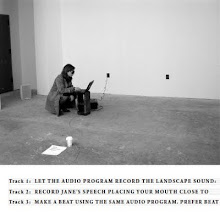
Georgia Sagri makes a live mix-tape of performance pieces she has presented in NY from 2007-2011. Invited by Sagri a group of friends develop a code ouji demonstration while her brother and activist Tasos Sagris will be answering questions about the current uprising in Greece, addressed by everyone present.


It is the making of the portfolio, its format, its banality of duration by adding the real and the live, like the leaking juices of fresh fruits, sticky fingers, too much nature, smelly and weird. The sounds of pain/ the cracking of fear/ the whispers of pause/ the abominable posture/ hand/ arm/ neck. The expression of the remembering of an incident but not the incident itself. Is that possible? Squeezed among some languages you know, you pretend you know, you want to know. Scratch it, suck mediations, which that could be a type of mimesis. Doing from directions coming from elsewhere. Rather unexpected than improvised. There is no 'as if'. It is the design of the portfolio. Making portfolio and forgetting portfolio. This was only a draft, some other things will come up and you will be noticed. The power point presentation will be totally and extremely burst with lying. "I wasn't expecting something different." Of course nothing will be placed in the correct chronological order. Are you accusing me of narcissism Apple > ?
"I love my i-phone." The i-pad portfolio and the fingernails' padpads on the keypord. Work in the mid of the summer and wonder what social class is. Hot is slow. Touch, skin and the right jeans. As always at the corner with the smoke in the mouth. An electric cigarette. The taste of look. How she moves her eyes when she is trying to be convincing, and how she stretches her neck every time she


7/13/2011

7/08/2011

Note

Crazyembarrasing
Superuncomfortable
Mindheartfuck
She is allergic to authority and carrots

7/07/2011

W.I.P for Women In Prison and Work In Progress (First Episode)

W.I.P for Women In Prison and Work In Progress (First Episode)


The head turns. The arm touches the ground, stopping violently. Movement comes out of the
speakers. It starts from zero on the timeline and leads to the end of the loop, its beginning.

Is it the machine that’s in question? Do you obey? Do you try to exist within it, against it, around it? The machine--machina in ancient Rome, mechane in ancient Athens--is still what we call the apparatus of war, all the weapons bought and sold, used and lost during battle: the armor, the gas masks, the Molotov cocktails, the cybernetic networks, prohibitions, negotiations, settlements and the camps (office camps, party regulations, yoga memberships, etc). It is the
theater and its apparatus: the entertainer's tricks and special effects, the lights going on and off, the curtains opening and closing, the fake blood, the props and costumes, the fluorescent paint on the masks that pin down the characters, the strings that hold ex-machina gods up in the air ready to turn various histories upside down whenever they settle, finally, for just a second on stage. It is the dubbed sound in Italian Spaghetti Westerns, the actors counting “one, two, three, four, five” instead of speaking sentences. It is Pier Paolo Pasolini adding sound to the film while editing the recorded images. It is Godard's subtitles, his obsession with texts on film and the way he reduces cinema’s speed. It is Roberto Rosellini's remote control gadget for zooming in and his preference for working with amateur actors. It is Maya Deren's cuts and the way she worked with film exposure. It is Jacques Tati’s mime routines, his micro-gestures and their connection to comedia de l'arte.

The machines of theater and the machines of war: they are interchangeable.
“How did it go?”
“Was it successful?”
Machine and tool are one and the same.

There are a million ways to compose and re-articulate a smile, a cry, and the hand holding a
glass. A million ways to rehearse and present a cry, a smile, and the hand holding a glass in real time.

They are modules: “the principle behind the distribution of breaks and intervals.”


There is no representation, only presentation and the analysis of the symptom’s mechanisms existing at the moment of the performance.


The tool I use in the performance is my female body. I was born with that body. I could resist it. I could change gender for the performance or pay other people to perform for me. Instead, I insist on presenting myself as I am. The female body with its texts, imagery, history, pain, criticism, revolt. With my female body I can do the gestures of a man and be that. I can be the lion and the fish and the tree and the woman again, another woman perhaps, another posture. I can't pretend
I am a non-smoker but I can look like I am a non-smoker. I can't hide my rotten teeth but I can smile in such a way as to camouflage them. That is what I have, simulations.

The women in prison told me that they have learned the techniques and the sensitivities of the State. They told me: “You must move from one point to the other and then back and forth without end.” I do what they told me in their letters. Is it cinema, then, and not performance? It is the war of the war machine, but not the war machine alone. The architectural plans, the social definitions, the prisons, the schools, the asylums, the houses, the offices, the pavements, the public spaces with their park security. It is life under the constant control of the structural,
behavioral and moral architects, with their pose of authority and calculated plans. And then there are the ideal citizens, the syncopated rhythms among thousands of them on the streets.

During a riot, though, different politics arise. There are expectations of change, forgotten demands, and the repressed imagination of the lower class. What does it mean to pretend to be a citizen? What does it mean to shout phrases that you don't believe in? What does it mean to shout together with a group of workers? Who are you when you are doing that? Are those your machines of survival your survival kits? Were you born with them or did you just get used to them as you grew up? The Father, the Mother, the Teacher, the Emperor and How am I to obey?
When is the right moment to put up the poster and when is the time to go home? Do I want to go to my place or do I want to live at our home?

This is not the end of the text.


Georgia Sagri, New York, 2011


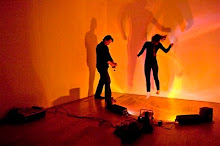
The performance W.I.P (First Episode) was presented as part of the exhibition Skin So Soft, organized by Josh Kline at Gresham's Ghost, 401 Broadway, NY, 6/22/2011, photo
by Linda Norden

5/28/2011

what I understand that you suggest about space of ease

As far as I can understand what you suggest by space of ease in connection to friendship could be habitus, but maybe we want to avoid the sociological connection of this word. We can use the word's origin which is hexis (έξις in greek) which means possession or disposition (διάθεσης in greek) power to use. The actual translation tends to be too pragmatic which suggests something that could be forcefully learned and then easily forgotten. I think Aristotle's refers to this notion as a having but it is always very controversial of how it is perceived this having. For how I understand it, is a topological, potential and formal term, but when we refer to it in relation to something else outside of himself then it is more as a state of action. An act can be good or bad and that's i think why friends are crucial. Because a friend for good that includes pleasure and benefit but it is not only one or the other, will express the good or bad of your act of the having. Isn't then space of ease the space of friendship that is cultivating truth? Certainly urgency isn't a pleasant feeling but in a moment of urgency wouldn't be urgent for something to be addressed ? For example if I feel sad because something needs to be said, happen, change, I need to say it. If that saying is articulated in a clumsy way it is because perhaps we haven't created a space of ease, space of comfort and pleasure where we don't feel like criminals as you said or we don't feel in survival and I think we both agree on that: I don't want to make you feel bad but I want you to feel free to address the good or the bad of the having.

x
g

David Hammons Toy

100%ad (sleep cat)


The advertisement 100% (sleep cat) was created in March 2010 and was hosted for six months at the site of the publication company 100%. Georgia Sagri as the advertising girl, the producer and the crew of her advertisement company, used here smiling styles and voice temperatures of 80's advertisements.